
Blog
How to Assess the Quality of Replica Bags
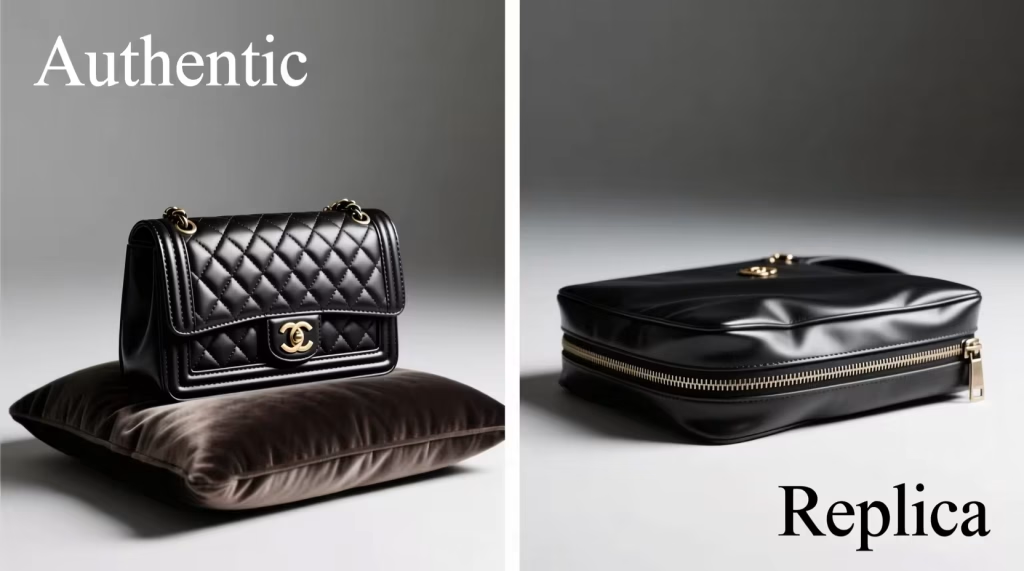
Feb
The fake market has developed much further than sham counterfeits crammed with knockoffs in the suitcases of street vendors. There is a new level nowadays–a sort of what is called by some, a mirror quality, or 1:1 replicas–which needs a real master to judge. Whether you are inspecting a Fake Louis Vuitton Neverfull or a Fake Gucci Dionysus, the difference between a convincing imitation and an obvious fake lies in the details most buyers never think to check.
This guide goes beyond novice suggestions. It dwells on the tactile, structural, and forensic evidence as professional authenticators apply it in the assessment of the quality of replicas. To correctly evaluate a fake bag, it will be necessary to detect where counterfeiters are compromising, which is the part that you have to train your eye to notice.
The Touch Test: Surface Texture and Hand-Feel.
Haptics- the responsiveness of the material to touch characterizes luxury goods. It has become easier to imitate the visual replication made by counterfeiters, but texture is hard to duplicate.
For a Fake Louis Vuitton:
True LV-covered canvas has a waxy surface. It is not slippery or sticky.
Drag your fingernail over it. All real canvas has a slight tooth; cheap imitations are like a smoother plastic tablecloth.
The back of the genuine LV canvas has a natural cotton shade with cross-weave being visible. Most of the counterfeits have artificial support dyed in beige.
For a Fake Gucci Bag:
The GG Supreme canvas Gucci uses is a muted sheen of a matte canvas. Replicas of high quality tend to fixate on perfecting it and thus, polish it too smoothly.
The leather items produced by Gucci are full-grain calfskin that fades. Fingerprint your thumb into the leather–real leather leaves a rebound mark. Hard, inelastic leather is an indication of corrected-grain or bonded assembly.
Structural Is integrity: Spine Test.
Luxury bags are created to uphold architecture. Leiman ships might seem to be right on a screen, but fall flat in practice.
Perform the spine test:
Find a flat area on which the bag can be placed and see whether it can stand on its own.
- A true Speedy or Neverfull maintains its shape when it is empty. A floppy silhouette is the hallmark of a low-tier Fake Louis Vuitton.
- On a Fake Gucci Bag, take a look at the bottom. Real Gucci Dionysus or GG Marmont bags are well-fitted with bottoms that do not bend. In case the base is easily bent by the slightest pressure, structural interfacing has no presence.
- Check side panels (gussets). They are to swell up without leaving any marks and to contract in a clean manner. Inequalities in gusset tension are evidence of hurried assembly.
Edge Painting and Glaze Work
One of the hardest processes to imitate is the painting that is done on the edges of the raw leather, the practice known as edge painting.
What to examine:
- Original edge paint is smooth, slim, and absolutely flush with the leather. It is not to be bubbled or to be showing on the surface.
- On a Fake Louis Vuitton, check the handle tabs and shoulder strap edges. LV has a thin coating of red, which is flexible. Replicas usually use thick, cracking paint that fractures or breaks away.
- On a fake Gucci Bag, examine the leather trim edges. The Gucci paint is applied in several layers to create a glassy effect on the paint. A single-layer application is thin and plastic.
- Follow your finger with the edge. When there are raised paint ridges or rough out areas, then the finishing work is low quality.
Interior Craftsmanship: The Secret Grand Tell.
Most buyers look at the outside; this is known to counterfeiters. Cost-cutting is often visible on the inside.
For a Fake Louis Vuitton:
- True LV microfiber lining is suede-like. It feels dense and plush.
- Poor quality imitations have short pile polyester, which is either rough or slippery.
- The external pocket stitching is to be identical to the internal. Wavy interior stitching implies general quality degradation.
For a Fake Gucci Bag:
- Gucci applies certain lining colors in each collection, activities such as rich jacquard or supple micro suede.
- The interior zipper pull. Interior hardware is engraved equally to exterior on genuine bags. The unmarked pull of a zipper is a warning sign.
- Interior leather patch must not be foil-stamped; it must be heat-stamped. Weaving fades; heat stamping becomes permanent.
Hardware Weighing and Acoustic Fingerprint.
Made-up components of metals are costly to produce. Zamak or brass alloy of high quality is very expensive compared to zinc or aluminum alternatives.
Perform the tap test:
Tap the hardware softly on a hard surface or a metal part.
- Hardware of authentic grade results in a heavy, low-pitched clink. Hardware rings hollow are of a more tinny sound.
- A Fake Louis Vuitton often uses hollow strap hooks that feel conspicuously light.
- A counterfeit Gucci Bag will have seam lines on the hardware that are visible because of the mold casting. Original Gucci hardware is cast in polished that is then cast to take away these lines.
- Check for magnetism. Elaborate quality hardware is usually not magnetic or only slightly magnetic. When a clasp is very attractive to a magnet, it has high amounts of iron- not in line with the luxury standards.
Font Forensic Analysis and Micro- Engraving.
Proprietary typography is a costly investment by the brands. One of the most stable points of authentication failures is font errors.
On a Fake Louis Vuitton:
- LOUIS VUITON is not an oval expression, but rather round.
- The width and the shoulder angle of the crossing bar in VUITTON are definite.
- The format of date code is of less importance now because of the microchip transition, although a lot of the imitations continue to use date codes before 2021 on fresh models.
On a Fake Gucci Bag:
When reflected, the g logo interlocking is supposed to create the perfect circles. Oval or misshapen Gs denote a forgery.
The interior “Gucci Made in Italy” stamp has a particular serif font with a characteristic letter ending. Copies tend to degenerate into generic Times New Roman or Arial derivatives.
Check inter letter spacing. True branding has uniform kerning; fakes tend to flatten out letters or place them in an uneven manner.
Specificity and Consistency of Pattern.
The luxury houses use waste materials to maintain pattern integrity. Counterfeiters maximize profits.
Examine seam junctions:
On a Fake Louis Vuitton, monogram flowers should never be cut in half at the seam. When a flower is cut off on the edge of a side seam or flap, the matching pattern will not match.
Speedy and Alma bags have a canvas pattern whose central area should be located on the front panel. The most typical mistake replicas make is off-center monograms.
On a Fake Gucci Bag:
The GG Supreme pattern is to be the same at the center seam. Wrong rows or inverted patterns are obvious signs of a counterfeit.
The width of the green-red-green stripes in the striped Web detailing must be kept in proportion. Stained or drawn-out lines indicate bootlegging.
Zipper Resistance and Zipper Function.
The quality of zippers is a general indication of hardware.
What to test:
- Real zippers swing against the uniform resistance. They are not caught, skipped, or resist being handled unnecessarily.
- LV also employs zippers marked with NVL, T.Y., or YKK font designation.
- Riri or Lampo zippers are commonly used at Gucci. Duplicates tend to use non-name-brand YKK or undetermined zippers.
- When completely closed, the zipper pull ought to be in contact with the stopper. Tolerance problems are evident in gaps.
Microchip and NFC Checkup.
In 2021, Louis Vuitton switched to microchips embedded. This generates an auth opportunity and mix up.
What to check:
If a bag claims to be a current-season model but contains a visible date code tag, it is a lv outlet.
Fine counterfeit products are implanted with fake NFC chips. Swipe the bag using an NFC smartphone. When it leads to a generic site or no information concerning the brand, the chip is fake.
The newer bags of Gucci have QR-code authenticity cards. They should be scanning into the official territory of Gucci – not into third-party verification sites.
The Ghost Bag Phenomenon
Advanced counterfeiters manufacture “ghost bags”—replicas of prototypes, sample sale pieces, or colorways that were never officially released.
How to protect yourself:
- Research the specific model year and season.
- Cross-reference the color combination against brand archives.
- A Fake Gucci Bag may appear in a “limited edition” color that Gucci never catalogued.
If the bag matches no known authentic reference images, it is not a replica of an authentic bag—it is a creative counterfeit.
Quick Assessment Checklist Rapid Replica.
- Assessment Area Red Flag (Low Quality) Green Flag (High Quality Replica)
- Surface Texture Shiny, sticky, plasticky Dry, matte, tactile grain
- Structural Rigidity Collapses When empty Structures become Autonomous.
- Edge Painting: Thick, bubbled, overlaps. Thin, flush, flexible.
- Interior Lining Rough polyester, generic pulls, Branded jacquard, weighted hardware
Hardware: Lightweight, smooth, deep, magnetic, seam lines. Heavy. - Font: Accurate fonts, irregular spacing, Proprietary typefaces, correct kerning.
- Pattern Alignment: Cut-off motifs, misaligned seams Continuous pattern, centering.
- Microchip/QR Visible date code, dummy NFC Functional scan (uncommon in replicas)
The Most Common Buying Mistakes Made by even veteran buyers.
The presence of weight is assumed to be a quality; some of the copycat products place weighted inserts to provide a false impression.
Being concentrated on the outside logo and not paying attention to the craftsmanship inside.
Reliance on the so-called authenticity cards- they are easy to counterfeit and not common among the luxury brands.
Giving too much importance to dust bags and packaging as quality evidence.
Frequently Asked Question
Is a strong chemical smell necessarily a fake?
This is not always the case but it is very suspicious. Real leather contains natural non-offensive scent. Volatile organic compounds are left behind by synthetic leather and low-quality adhesives.
Is a replica able to pass all these tests?
The best imitations (mirror) at the top-tier cost (e.g. $500 and more) can survive 80-90 percent visual and touch examination. They are usually not successful at the micro-engraving, NFC functionality, and the long-term durability test.
Why does a counterfeit weigh heavier than a genuine bag?
To imitate the weight of authentic hardware, some counterfeiters have to use metal plates or weight strips. Weight is only useful when there is a combination of other quality markers.
Are brand boutiques the authenticators of bags?
The vast majority of the brands do not offer written authentication. The third-party professional authenticators are the most effective sources of verification.
Final Thoughts
The evaluation of the quality of the replica bags is a process that evolves as a result of conscious observation. It is not an individual detail that makes the difference between a low grade fake and a high-end copy, but the uniformity of the craftsmanship. A Fake Louis Vuitton may nail the monogram color but fail at edge painting. A Fake Gucci Bag may be perfect in terms of the leather touch but will have the wrong font spacing on the internal tag.
There are hundreds of quality checkpoints in luxury brands. Even at the top echelons, counterfeiters are bound to compromise somewhere in the corners. Your job is to find where. You are no longer guessing but have a system of evaluation of construction, materials, hardware and branding.
